How to Choose AI Autoblogging Tools with CMS Integrations: A Buyer's Guide
You picked an AI writing tool. Now you find out it cannot publish to your CMS. The gap between generating text and getting it live is where most stacks quietly break.
This guide shows you how to judge CMS integrations, bulk CSV generation, AI modes, and credit rollover before you buy. You will finish knowing which plan fits your blog, agency, or client roster, and whether Autoblogging.ai belongs in that shortlist.
What Is Autoblogging.ai? A Buyer's Guide to the Platform
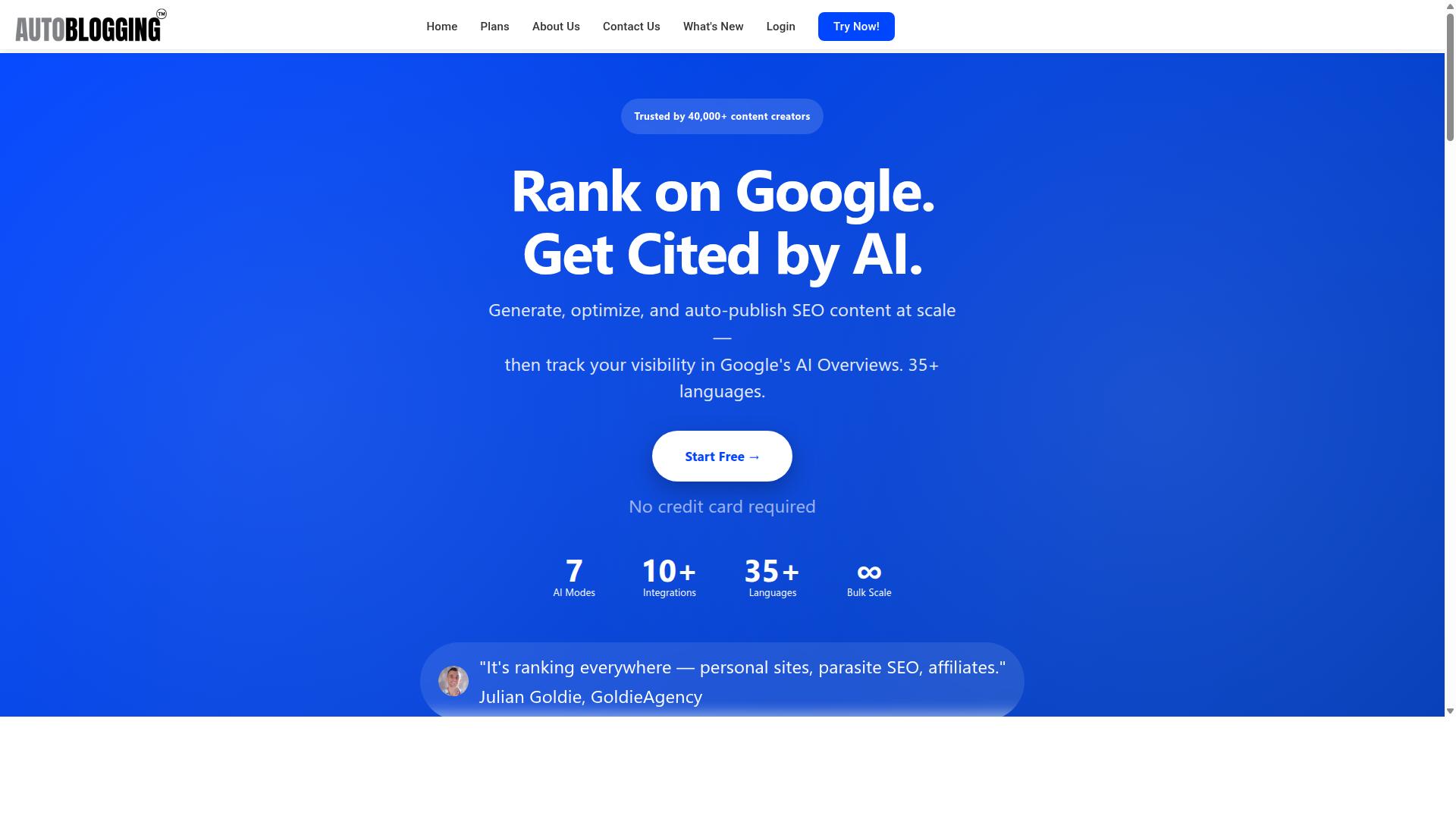
Autoblogging.ai is an AI-powered content automation platform that generates and publishes articles directly to your CMS, designed for bloggers, agencies, and SEO professionals. Instead of writing every post by hand, users rely on the platform to produce content and push it into their websites through connected integrations.
The core purpose is simple: save time and improve online presence through automation. For anyone running multiple sites or managing content at scale, that combination matters more than almost any other feature. Autoblogging.ai is a product of Digimetriq.com, and its stated mission is to help bloggers, website owners, and agencies cut content costs while enableing human teams in their standard operating procedures with a solid first draft.
It serves a global audience, which means the platform is not tied to one market, language, or region. That reach also shapes how buyers should evaluate it. Integrations, content quality, and workflow fit vary by user, so a careful assessment matters.
This article is a buyer's guide, not a sales page. It walks through what Autoblogging.ai does, who it suits, and why CMS integrations should sit at the center of your decision. The goal is to help you judge whether the platform matches your publishing setup before you commit.
Who Autoblogging.ai Serves and What It Does
Autoblogging.ai is built for bloggers, website owners, SEO professionals, marketing agencies, content creators, and affiliate marketers who need to scale content production. These are people who publish often and cannot afford to treat every article as a manual project.
The platform fits a wide range of site types, including:
- Personal sites and blogs
- Parasite SEO properties
- Affiliate sites
- Client websites managed by agencies
- Portfolio sites
- Local sites
That spread says something useful about the tool. It is not limited to one niche or one business model. A solo blogger and an agency juggling client websites can both find a use for automated content creation, even if their workflows look nothing alike.
In terms of function, Autoblogging.ai generates articles using AI and supports multiple modes, then connects with a CMS for automated publishing. The publishing side is what separates a content generator from a true content automation platform. Generating text is one step. Getting it live on your site without manual copying is the step that actually saves hours.
Because the platform serves users globally, buyers should think about their own setup first: the CMS they run, the volume they publish, and the review process they need. Those factors determine how much value they get from the tool.
Why CMS Integrations Matter When Choosing an AI Autoblogging Tool
CMS integrations determine how seamlessly an AI autoblogging tool fits into your existing publishing workflow, affecting everything from setup time to content scheduling. Without an integration, you generate an article, then copy it, paste it, format it, and publish it by hand. That defeats the purpose of automation entirely.
With a working integration, the benefits stack up quickly:
- Scheduled posts that publish on your timeline, not when you remember to log in
- Bulk content generation pushed to the site in batches rather than one at a time
- Preserved SEO structure, including categories, tags, and URL patterns you already use
- Less manual editing, which reduces formatting errors and broken layouts
Integration quality varies by platform. WordPress is the most common target for AI autoblogging tools, typically handled through plugin compatibility. Other systems, such as Shopify, Wix, Ghost, and Webflow, may rely on API connectivity or a headless CMS approach.
For buyers, the practical question is straightforward. Does the tool connect to your content management system, and does that connection support the way you publish? A platform with strong content quality but weak integration creates manual work you were trying to eliminate. That is why integration deserves a place near the top of your evaluation checklist, alongside content quality and SEO handling.
How to Evaluate CMS Integrations in an AI Autoblogging Tool
Evaluating CMS integrations requires checking compatibility with your platform, the depth of API connectivity, and whether the tool supports automated publishing and scheduling. Get any one of these wrong and you end up copying and pasting articles by hand, which defeats the purpose of content automation.
Start with a simple compatibility audit. List every platform your team publishes on, then confirm the tool connects to each one. A tool that only serves WordPress may be fine for a single blog, but agencies and multi-brand operations need broader reach.
Next, look at how the connection is built. Native plugins tend to be easier to set up and maintain, while API-only connections offer more flexibility for custom or headless CMS setups. Ask whether the integration supports scheduled posts, category assignment, and media handling such as featured images.
- Supported platforms: WordPress, Shopify, Wix, Ghost, Webflow, Blogger
- Connection type: native plugin, API, or both
- Publishing controls: scheduling, bulk actions, category and tag assignment
- Media handling: images, featured images, and formatting retention
Always test with a small batch before full adoption. Publish a handful of articles to a staging site, check how meta tags, schema markup, and internal linking survive the transfer, then scale once the output looks right. This mirrors the human-in-the-loop approach that keeps editorial standards intact.
One-Click WordPress Publishing and 35+ Integrations
Autoblogging.ai offers one-click publishing to WordPress and supports over 35 integrations with other CMS platforms, streamlining content deployment. You connect your site once, through a plugin or API, then publish directly from the Autoblogging.ai dashboard without leaving the tool.
The WordPress integration covers unlimited sites and supports scheduled auto-posting, so content can go live on a cadence you define rather than all at once. That matters for sites that want a steady publishing rhythm instead of sporadic bursts.
Beyond WordPress, the platform connects with Shopify, Wix, Webflow, Blogger, and Ghost, plus Web 2.0 destinations including Medium, Dev.to, Hashnode, Telegraph, and Tumblr. Connections are also available through API, Zapier, and n8n, which helps teams working with custom or headless CMS environments where a standard plugin will not fit.
When you compare AI autoblogging tools, weigh integration breadth against your actual publishing footprint. A single WordPress blog needs far less than an agency running client sites across several content management systems. Autoblogging.ai's spread across both traditional and headless setups means most teams can route generated content straight to the platforms they already use, with scheduled posts and bulk actions handled inside one workflow.
Bulk Generation via CSV: Up to 500 Articles Per Run
Autoblogging.ai supports bulk content generation via CSV upload, allowing users to create up to 500 articles in a single run. The workflow is straightforward: prepare a CSV containing your keywords, titles, or prompts, upload the file, and the tool generates the articles in bulk.
For agencies managing multiple clients or large sites with deep content libraries, this changes the economics of production. Instead of queuing topics one at a time, you can plan an entire content calendar in a spreadsheet and process it in one pass. That is the difference between hours of manual work and a single upload.
Generated articles can then be published automatically to integrated CMS platforms, so the bulk run feeds directly into the same publishing pipeline described above. Combine bulk generation with scheduled auto-posting and you have a repeatable system: plan in CSV, generate in bulk, publish on schedule.
Before committing a full batch, run a smaller test file through the same process. Check that categories land correctly, media attaches as expected, and formatting holds up on your platform. Once the small batch looks right, scale to larger runs with confidence. For teams weighing AI autoblogging tools, bulk CSV support paired with broad CMS integrations is one of the clearest signals that a platform can handle real production volume, not just occasional posts.
Content Quality and AI Modes to Look For
Content quality in AI autoblogging tools hinges on the underlying AI modes, which determine how well articles match search intent and rank in search engines. Two tools can both claim to "write articles with AI," yet produce wildly different results depending on what happens before the first sentence is generated.
Some platforms rely on basic generation: a prompt goes in, a generic article comes out. More sophisticated systems study the search results page first, pull out the terms and entities that top-ranking pages share, and build the article around that data. That difference shows up directly in content quality.
When you evaluate AI autoblogging tools for a buyer's guide shortlist, judge output on three fronts:
- Readability: clear structure, natural phrasing, and a tone that fits your brand voice
- SEO optimization: keyword usage, meta tags, schema markup, internal linking, and overall keyword research alignment
- Factual accuracy: claims that hold up, with plagiarism detection and proofreading steps to catch problems before publishing
Autoblogging.ai approaches this with distinct AI modes rather than one setting. These include Godlike Mode, Quick Mode, News Mode, and Amazon Reviews Mode. Each targets a different job, from competitive ranking plays to fast drafts and affiliate content. The sections below break down what each mode does and when it makes sense.
Godlike Mode: SERP Competitor Analysis, LSI Keywords, and Knowledge Graphs
Godlike Mode is Autoblogging.ai's most advanced AI mode, performing SERP competitor analysis, extracting LSI keywords, and leveraging knowledge graphs to produce in-depth, SEO-optimized articles. Instead of generating from a blank prompt, it starts by studying what already ranks for your target keyword.
From that analysis, it identifies LSI keywords and entities, the related terms and concepts that search engines associate with a topic. A knowledge graph extraction step then helps enrich the content so it covers the subject with more depth than a surface-level draft. The result is an article built around actual search intent rather than guesswork.
Why does this matter for ranking? Search engines reward pages that answer a query thoroughly and demonstrate topical authority. By grounding each article in competitor data and related entities, Godlike Mode gives content a stronger shot at higher relevance and more complete coverage of what readers expect to find.
This mode suits competitive niches where thin content will not survive. If your keyword has established pages holding the top spots, a mode that reverse-engineers those results is a smarter starting point than raw generation. It pairs naturally with optimization tools like Semantic SEO Analysis, a 21-point audit, and the Snippet Optimizer for refining what gets produced.
Quick Mode, News Mode, and Amazon Reviews Mode
Beyond Godlike Mode, Autoblogging.ai offers Quick Mode for free single articles, News Mode for timely content, and Amazon Reviews Mode for affiliate product reviews. Each fills a different gap in a content workflow.
Quick Mode is the free entry point, available as a single article generator and a wizard. It works well for testing the platform, drafting short pieces, or producing content where speed matters more than deep SERP analysis.
News Mode connects with Google News to support timely content. This is useful for newsjacking, where publishing quickly on a trending topic can capture search interest while it is still rising. Speed is the whole point here, and the mode is built around that need.
Amazon Reviews Mode generates product reviews aimed at affiliate marketers. If your monetization depends on product recommendations, this mode targets that format directly rather than forcing a general-purpose generator to imitate a review structure.
All modes feed into the same publishing layer, which matters for anyone weighing CMS integrations. Autoblogging.ai supports WordPress integration with unlimited sites, one-click publishing, a plugin, and scheduled auto-posting. It also covers Web 2.0 platforms like Medium, Dev.to, Hashnode, Telegraph, and Tumblr, plus multi-platform publishing to Shopify, Wix, Webflow, Blogger, and Ghost, along with API, Zapier, and n8n connectivity. That range means the mode you choose does not lock you into a single destination for automated publishing.
Pricing, Credits, and Rollover: What Buyers Should Compare
When comparing AI autoblogging tools, pricing models, credit systems, and rollover policies significantly impact long-term value and scalability. Two tools can advertise a similar monthly fee yet deliver very different amounts of usable content once you break the numbers down.
The first step is understanding what you are actually paying for. Some platforms charge per word, others charge per article, and many use a credit system where each generation consumes one or more credits. None of these models is inherently better, but they are not directly comparable until you convert them to a single figure.
That figure is your cost per article. Divide the monthly price by the number of articles or credits included, then compare that result across tools. A plan that looks cheaper on the sticker price can end up costing more per finished post.
- Credits per article: confirm how many credits a single generation consumes
- Monthly cost: check the real total, including any add-ons you will need
- Rollover policy: find out whether unused credits carry over or expire
- Scalability: verify how pricing changes as your content volume grows
Rollover deserves special attention. If you publish in bursts, say a large batch one month and very little the next, a no-rollover policy means you effectively pay for credits you never use. A rollover policy turns unused capacity into a buffer for busier periods.
Finally, think about scalability. A plan that fits ten articles a month may become expensive or restrictive at fifty. Buyers should map their expected output over the next six to twelve months before committing, so the pricing model still works when content needs grow.
Autoblogging.ai Plans from $19 Starter to $999 Enterprise
Autoblogging.ai offers monthly plans ranging from a $19 Starter plan with 40 credits to a $999 Enterprise plan with 5,000 credits, with annual billing options available. The full lineup gives buyers a clear ladder to climb as their content needs expand.
| Plan | Monthly Price | Credits |
|---|---|---|
| Starter | $19 | 40 credits |
| Regular | $49 | 120 credits |
| Standard | $99 | 300 credits |
| Gold | $179 | 600 credits |
| Premium | $249 | 1,000 credits |
| Enterprise | $999 | 5,000 credits |
Annual billing lowers the effective monthly rate on every tier. For example, Starter drops to $12/mo ($148/year), Regular to $32/mo ($382/year), Standard to $64/mo ($772/year), Gold to $116/mo ($1,396/year), Premium to $162/mo ($1,942/year), and Enterprise to $649/mo ($7,792/year).
Every plan includes credits rollover, so unused credits are not lost at the end of a billing cycle. New accounts also receive 10 free credits per month with no credit card required, which lets buyers test the workflow before paying. Additional credits can be purchased separately if you need more than your tier provides.
A credit represents one article generation, so the math is straightforward: a Starter plan covers roughly 40 articles per month, while Enterprise covers 5,000. Before choosing a tier, estimate your monthly content needs, including scheduled posts and bulk content generation for multiple sites, then pick the plan that covers that volume with a little headroom.
For buyers who prefer not to run the tool themselves, Done For You packages are also available: Starter at $1,200 for 1,000 articles, Pro at $1,600 for 1,000 articles, Corp at $4,000 for 1,000 articles, and Senpai at $10,000 for 1,000 articles. Payment options include Visa, MasterCard, American Express, and PayPal, with bank transfers available for annual enterprise plans via Stripe, and you can cancel anytime.
Trust Signals: Track Record, Ratings, and Testimonials
Trust signals such as user count, article volume, ratings, and testimonials provide confidence that an AI autoblogging tool delivers on its promises. Anyone comparing tools in a buyer's guide should treat these signals as seriously as feature lists and CMS integrations.
Features tell you what a platform claims to do. Trust signals tell you whether real people stuck around long enough to prove it. A tool can advertise 35+ integrations and 10+ AI modes, but without evidence of actual usage, those claims stay theoretical.
When evaluating trust signals, look for specific numbers rather than vague praise. A user count in the tens of thousands, an article volume in the millions, and a rating close to a perfect score are all verifiable markers of scale and satisfaction. Vague statements like "thousands of happy customers" without figures deserve more skepticism.
Named testimonials carry more weight than anonymous quotes. When a review comes from a professional with a public profile, such as an agency owner or a recognized SEO practitioner, you can check their background and judge whether their experience reflects your own needs. Look for a mix of voices: agency operators, solo creators, and technical users.
Ratings deserve context too. An average rating of 4.9 across a large user base suggests consistent satisfaction, while the same score from a handful of reviewers means very little. Numbers, names, and volume together form a complete picture.
Additional trust factors include responsive support and a steady release cadence. A vendor that ships improvements regularly signals active development rather than a stagnant product. These signals set up the specific track record covered below.
40,000+ Content Creators, 1M+ Articles, and a 4.9 Average Rating
Autoblogging.ai is trusted by over 40,000 content creators and has generated more than 1 million articles, holding a 4.9 average rating. Those figures place it among the more established names in content automation, and they answer the central question of whether the platform is legitimate.
The user base spans solo bloggers, affiliate marketers, and agencies running content operations at scale. A rating of 4.9 suggests that the combination of features, including 10+ AI modes, 35+ languages, and 35+ integrations, matches what buyers actually need from a CMS-connected autoblogging tool.
Named testimonials reinforce the numbers. Julian Goldie of GoldieAgency, whose YouTube channel has 250k+ subscribers, has endorsed the platform. James Dooley of FatRank and PromoSEO, Bart Magera of MojoLinks, Kyle Duncan, an SEO professional, and Dimitar Georgiev, CEO of IDEAMAX.EU, have also shared positive experiences. These are people with public reputations in search and content marketing, which makes their feedback easier to weigh.
Beyond ratings and reviews, several operational factors support the track record:
- 24/7 support for users who need help at any hour
- New features shipped weekly, showing ongoing development
- A human proofreader included in all plans, adding a quality layer to automated output
- Credits rollover, so unused capacity is not wasted
Together, these signals point to a platform with a proven record rather than an unverified promise. For buyers weighing CMS integrations and content automation, the scale of adoption and the calibre of named users provide a solid basis for confidence.
Who Should Choose Autoblogging.ai
Autoblogging.ai is best suited for bloggers, marketing agencies, affiliate marketers, and SEO professionals who need to scale content production across multiple CMS platforms. These are the people who feel the pressure of publishing consistently, often across several properties at once, and who need a tool built around output rather than one-off drafts.
The platform serves a wide range of site types, including personal sites, affiliate sites, client websites, portfolio sites, local sites, and parasite SEO projects. That spread matters because it shows the tool is designed for volume and variety, not a single narrow use case.
Below are the profiles that tend to get the most value from it, along with the situations where it fits best and the cases where a different approach makes more sense.
- Bloggers and website owners running one or more properties who need a steady publishing rhythm without writing every post by hand.
- Marketing agencies producing content for client websites and juggling several brands, voices, and deadlines at once.
- Affiliate marketers who rely on product reviews and comparison content to drive traffic and commissions.
- SEO professionals focused on ranking, who need content volume to support keyword coverage and internal linking.
- Content creators managing portfolio sites or multiple niche projects in parallel.
For agencies, the appeal is straightforward. Client work often means bulk content generation across several WordPress installs, and a tool that supports that workflow removes a major bottleneck. Instead of treating each article as a separate project, teams can work in batches and keep multiple clients moving at the same time.
Affiliate marketers have a similar need but a different shape. Review content has to cover many products, many keywords, and many angles, which naturally pushes toward high-volume production. Autoblogging.ai fits that pattern well because it is built for generating content at scale rather than polishing a single piece.
SEO professionals get value from the same strength. Ranking strategies usually depend on covering a topic thoroughly, and thorough coverage takes volume. When the tool handles the heavy lifting of production, the SEO side of the work, keyword research, meta tags, and internal linking, gets more room to breathe.
Autoblogging.ai also stands out in a few specific scenarios. The first is bulk generation, where the goal is producing many articles rather than one. The second is publishing to WordPress, which remains the most common home for blogs and affiliate sites. The third is access to advanced modes such as Godlike, which gives users a higher tier of generation when standard output is not enough.
That combination makes the tool a strong match for anyone whose main constraint is production capacity. If publishing more content is the fastest path to your goals, the fit is clear.
There is also a practical limit worth naming. Autoblogging.ai is not the right choice for someone who needs a fully custom content strategy built entirely by hand, with no AI assistance at any stage. If every article must be researched, outlined, and written from scratch by a human, the tool's core strength becomes irrelevant.
The same applies to anyone who wants to avoid automation altogether. This is a platform for people who are comfortable letting software carry part of the workload. For those who are, the value is easy to see.
In short, Autoblogging.ai is a strong fit for bloggers, agencies, affiliate marketers, and SEO professionals who need to produce content across multiple CMS platforms at scale. It excels at bulk generation, WordPress publishing, and advanced modes like Godlike, and it is honest about where it stops. If your goal is more content without more hours, this is a tool built for exactly that.
Final Verdict: Is Autoblogging.ai the Right CMS-Integrated Tool for You?
Autoblogging.ai stands out as a CMS-integrated AI autoblogging tool with robust features, competitive pricing, and strong trust signals, making it a top contender for content automation. For buyers working through this guide, the question is not whether the tool has merits, but whether its particular mix of strengths and tradeoffs fits how you publish.
On the strengths side, the platform supports 35+ integrations, which matters in a market where plugin compatibility and API connectivity often decide whether automated publishing works at all. The Godlike Mode feature gives users a higher-tier content generation option, and credit rollover adds practical flexibility for teams whose publishing volume fluctuates month to month.
A large user base also serves as a trust signal. When many publishers rely on a tool for scheduled posts and bulk content generation, that adoption is reasonable evidence the CMS integrations hold up in real workflows rather than only in demos.
No tool is perfect, and two considerations deserve honest weight. First, pricing is credit-based, so costs scale with output. Buyers should estimate monthly article volume before committing. Second, AI-generated content still benefits from human editing, a standard reality across large language model tools.
Who is it for? Autoblogging.ai suits bloggers, agencies, and marketing teams that publish at volume through a content management system and want automation without building a custom pipeline. If you publish occasionally and edit heavily, a simpler tool may be enough. If volume and integration matter, this is a strong candidate.
Next steps are straightforward. Try a free plan to confirm the integrations match your CMS, and contact support with setup questions before committing to a paid tier.
- India office: 501, Trinity Orion, Vesu, Surat - 395007, Gujarat, India
- Phone/WhatsApp: +91 84605-06553 / +91-8460506553
- Email: vaibhav@autoblogging.ai
- Skype: vibes.yb
- Hours: 7:00-19:00 IST
- United Kingdom: 2nd Flr, SEO Content Suite, 35 Water Ln, Wilmslow, Cheshire SK9 5AR
- UK phone: +44 1625 359056
- Social: Facebook, Twitter, LinkedIn
On balance, Autoblogging.ai earns a favorable verdict. The integration range, feature set, credit rollover, and established user base outweigh the credit-based cost model and the universal need for editorial review. For CMS-driven content automation, it is a credible, well-supported choice.
Frequently Asked Questions
What should I look for in an AI autoblogging tool's CMS integrations?
The integration should let you publish directly to the platforms you actually use-whether that's WordPress or another CMS-without copy-pasting drafts by hand. Autoblogging.ai supports 35+ integrations, so it's worth checking that your specific CMS is covered before you buy. Also confirm whether the tool can schedule, set categories, and assign authors, since those details determine how much manual cleanup you'll still face.
How is Autoblogging.ai different from a basic AI writer?
Autoblogging.ai is built specifically for automated content publishing rather than one-off article drafting. It offers 10+ AI modes, including Quick Mode for fast single articles, Godlike Mode with SERP competitor analysis, LSI keywords and knowledge graph extraction, Bulk Generation for up to 500 articles via CSV, and News Mode. That range makes it suited to bloggers, agencies and affiliate marketers running content at scale, not just occasional writing.
Do I need technical skills to connect Autoblogging.ai to my site?
No-the platform is designed for bloggers, website owners and agencies rather than developers. With 35+ integrations available, the goal is to connect your CMS and publish without custom coding. If you do hit a snag, support is available 24/7 to help with setup.
How much does Autoblogging.ai cost, and which plan fits my needs?
Monthly plans start at $19 for 40 credits and scale up through Regular ($49/120 credits), Standard ($99/300 credits), Gold ($179/600 credits), Premium ($249/1,000 credits) and Enterprise ($999/5,000 credits), with annual options also available. Credits roll over, so unused capacity isn't wasted between billing periods. If you're publishing a handful of posts a month, a lower tier works; agencies and bulk publishers should look at the higher-credit plans.
Can I generate content in languages other than English?
Yes. Autoblogging.ai supports 35+ languages, which is useful if you run multilingual sites or serve clients in different regions. Combined with the CMS integrations, you can publish localized content to the relevant sites without switching tools.
Is Autoblogging.ai reliable enough for client and agency work?
The platform is trusted by 40,000+ content creators with a 4.9 average rating and 1M+ articles generated, and a human proofreader is included in applicable plans. It's used across personal sites, affiliate sites, parasite SEO, client websites and local sites. For agencies, features like Bulk Generation and credits rollover help manage multiple client projects efficiently.